
Delta Robots vs. Traditional Robots: Why They're the Ultimate Choice for Pick & Place
By Omar Abdulhadi, PhD · October 11, 2026
Ask ten automation engineers which robot to put on a pick-and-place line and you will hear “it depends” ten times. They’re right. But for one very common job — moving light products quickly from a conveyor into a tray, box, or another conveyor — one architecture keeps winning: the delta robot.
This article explains why, where traditional robots still make more sense, and how to tell which one your line needs.
Two Ways to Build a Robot Arm
Traditional industrial robots — six-axis articulated arms and SCARA robots — are serial machines. Each joint is mounted on the one before it, like a human shoulder, elbow, and wrist. That gives them long reach and a lot of freedom to orient a tool, but every motor has to carry the motors and links that come after it.
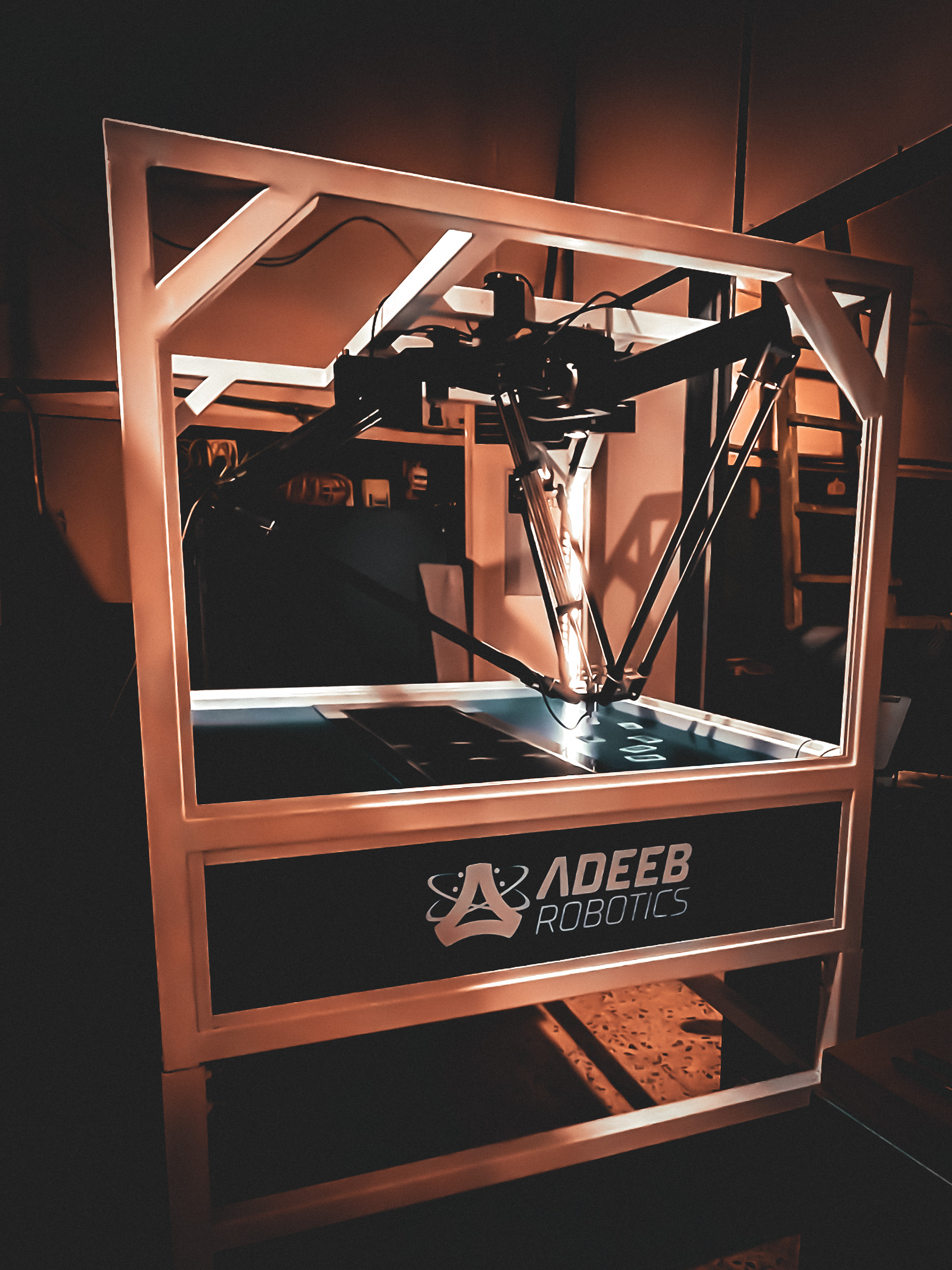
Delta robots are parallel machines. Three arms connect a fixed base above the work area to a small moving platform below it. The motors stay on the base and never move. Only the lightweight arms and the platform travel with each pick.
That one design decision drives almost every difference that follows.
Why Delta Robots Win at Pick & Place
Speed comes from low moving mass
Because the motors stay on the fixed base, a delta robot accelerates very little mass on each move. That is what makes high cycle rates possible. The Adeeb Delta Robot is rated for 100+ picks per minute on a 25 g payload over 305 mm of travel, with a maximum speed of 10 m/s.
Precision that holds at speed
In a serial arm, small errors at each joint add up along the chain. In a parallel design the arms share the load and constrain each other, which keeps the platform stable at high speed. Our Delta Robot is specified for ±0.05 mm repeatability: tight enough for tray loading, kitting, and placement work that feeds downstream processes.
It stays out of the way
A delta robot mounts overhead and works downward into a cylindrical envelope (1000 mm in diameter on our Delta Robot). Nothing sits on the floor beside the conveyor, which leaves room for operators, cleaning, and maintenance, and lets you place robots close together along a line.
Built for moving targets
Most pick-and-place work happens on a moving belt. Our pick-and-place solution pairs the Delta Robot with integrated vision and encoder-synced conveyor tracking, so the robot picks each product where it will be rather than where it was. EtherCAT keeps the camera, conveyor, and motion synchronized, and lets several robots in a cell share the work without timing conflicts.
Quick product changeovers
Mixed-product lines live and die by changeover time. The Delta Robot’s quick-change tooling supports a tool-less end-effector swap in under 30 seconds, so moving between a vacuum cup and a gripper doesn’t stop the line for long.
When a Traditional Robot Is the Better Choice
Delta robots are specialists. A serial arm is the better tool when the job needs:
- Long reach or a large work envelope, such as reaching across a wide pallet or into deep bins.
- Heavy payloads. Delta robots are designed for light, fast picks, while serial arms are built to carry more.
- Full tool orientation. A six-axis arm can tilt and rotate a tool in any direction. A delta robot moves in X, Y, and Z, with an optional rotary axis (Rz) for turning the product.
- Complex paths, like welding seams, dispensing along a contour, or tending a machine through a door.
Palletizing heavy cases or reaching into a CNC machine is a job for an articulated arm. Picking a hundred small products a minute off a belt is a job for a delta robot.
Quick Comparison
| Delta robot | Articulated / SCARA arm | |
|---|---|---|
| Kinematics | Parallel, motors on a fixed base | Serial, motors carried by the arm |
| Strength | Speed on light payloads | Reach, payload, and tool orientation |
| Mounting | Overhead, above the conveyor | Floor, pedestal, or table |
| Degrees of freedom | 3, plus an optional rotary axis | Typically 4 (SCARA) to 6+ |
| Best fit | High-speed picking, packing, sorting | Palletizing, machine tending, complex paths |
One Controller, Either Way
You don’t have to bet your software stack on one robot type. The Adeeb Robot Controller drives delta robots, SCARA robots, palletizers, and 6/7-axis arms, with native conveyor tracking and a Python programming interface. Your team learns one system, and each cell gets the robot that fits its job.
Find the Right Robot for Your Line
If your line moves light products at high rates (food and beverage, consumer goods, electronics, pharmaceuticals, or recycling), a delta robot is very likely the right choice. Explore the Delta Robot, see how RePlastic Recycle deployed one, or book a demo and we’ll help you size the right cell for your application. Have a different job in mind? Contact our engineers and we’ll tell you honestly which robot fits.